
Improving the indoor climate in the office: A guide to increased well-being and productivity
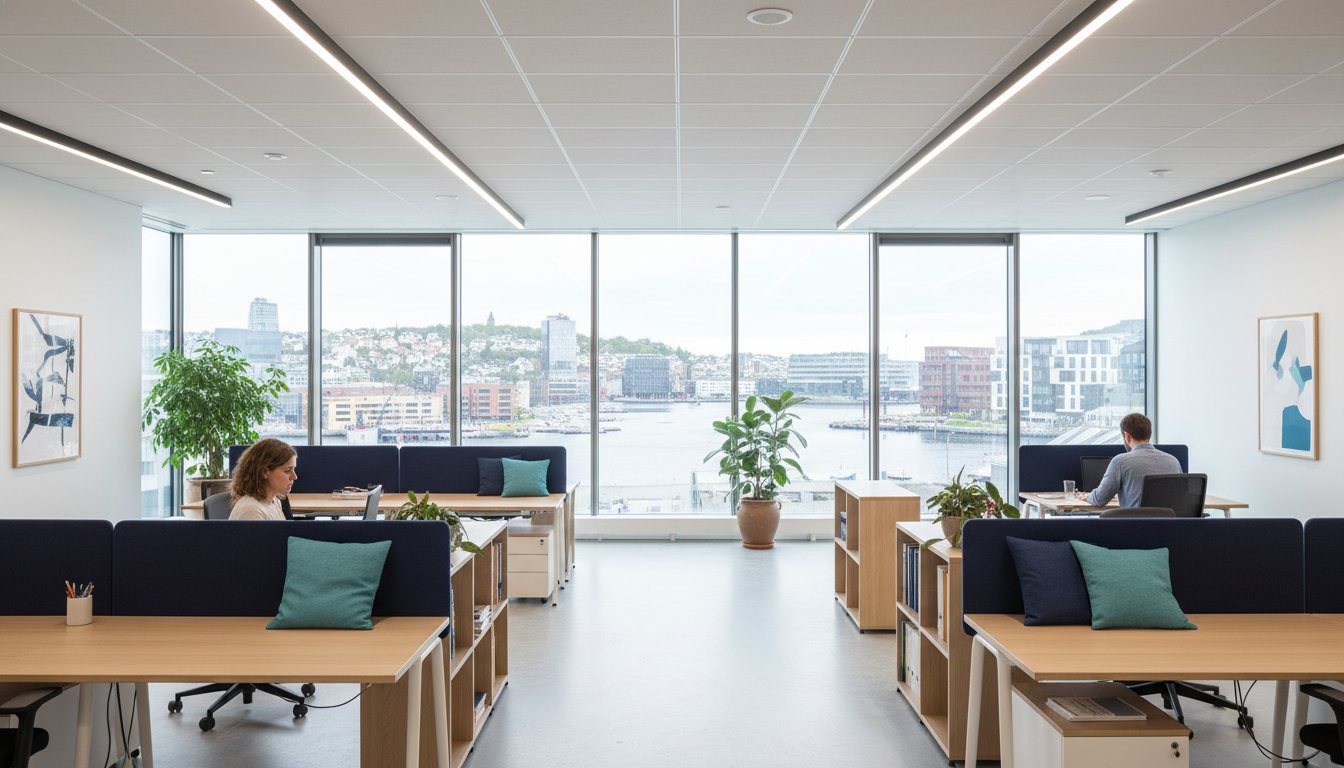
Your brain capacity can actually plummet by two-thirds on days with poor air quality, according to research from Harvard. Yet thousands of employees sit in spaces that drain their energy every single day. Improving the indoor climate in the office isn't just about comfort. It's pure math for the bottom line. When the air is stagnant and the sun glares on your screen, productivity dies. According to STAMI, symptoms such as headaches and abnormal fatigue occur five times more frequently in buildings with poor indoor climate compared to buildings with optimal conditions.
We know exactly how it feels. The heavy fog in your head after lunch. Glare that forces you to squint at the screen. Office landscapes that feel like a greenhouse in the summer and a cold storage room in the winter. It's exhausting for both body and soul. But there's a way out of the slumber. This guide teaches you how to transform your workplace from a tired space to an energetic powerhouse by mastering air, light, and heat.
We delve into how to take control of your work environment with surgical precision. You'll gain insight into the latest requirements for ventilation and lighting, as well as how smart solutions like solar film and smart glass can eliminate temperature problems for good. The goal is simple: fewer sick days, more alert minds, and a modern office space that oozes visual power and professionalism.
Important Points
- Understand why improving the indoor climate in the office requires a holistic approach to both air quality, lighting control and thermal stability.
- Eliminate headaches and fatigue by mastering daylight and eliminating annoying screen glare once and for all.
- Learn the tricks to keep the temperature in the golden zone between 20 and 22 degrees, no matter how much the sun bakes or the winter bites.
- Explore how dynamic solutions like smart film and solar film can upgrade your office into a modern, attractive and energetic powerhouse.
- Get a concrete 5-step checklist to go from theory to action and create immediate results for employee well-being.
What does it really mean to improve the indoor climate in the office?
We spend 90% of our lives indoors. For most of us, that means thousands of hours in an office environment. If this environment is out of balance, the workplace becomes a source of exhaustion rather than creativity. Improving the indoor climate in the office is about much more than just opening a window. It’s a complex equation. Air quality, temperature, light and sound must all be aligned in a higher unity for employees to perform at their peak.
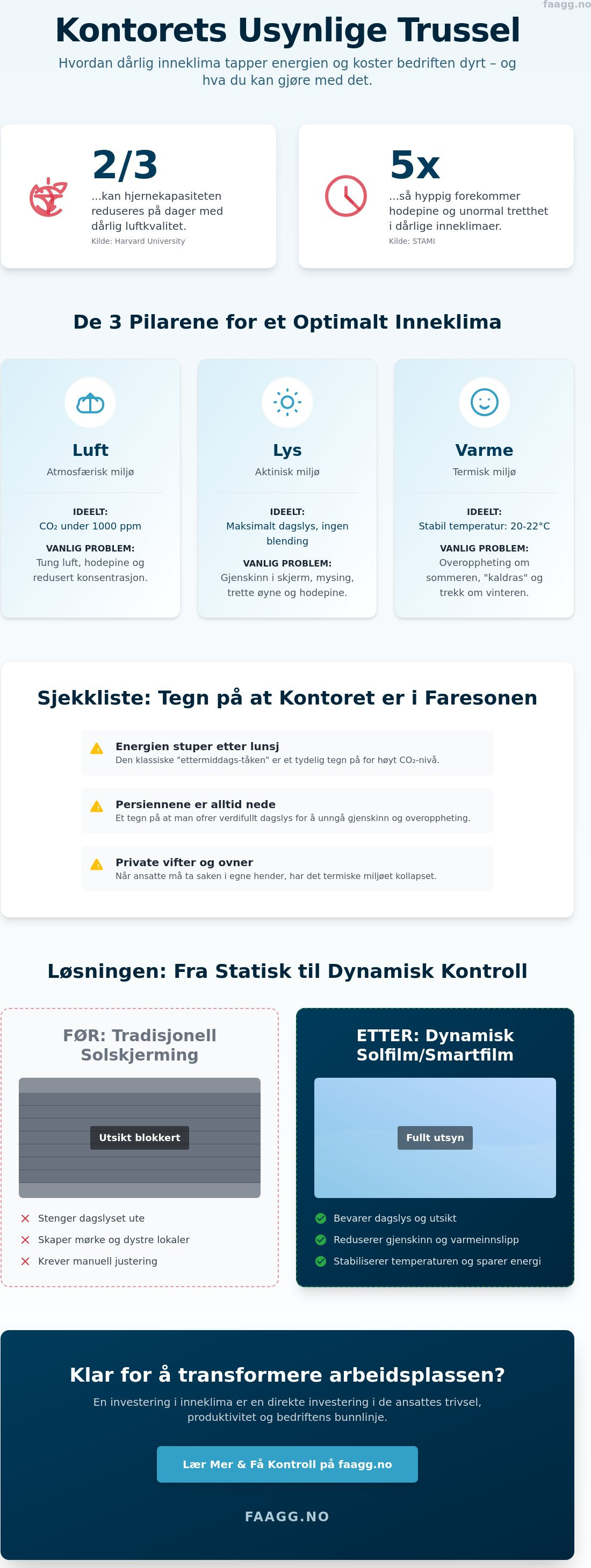
When we talk about What is indoor air quality , we look at the invisible architecture that surrounds us. Poor indoor air quality is the direct cause of "Sick Building Syndrome". This is not a vague hypothesis. The Swedish Working Environment Institute (STAMI) is clear: symptoms such as headaches and extreme fatigue are five times more prevalent in buildings with poor air quality. These are frightening figures for any manager who cares about results.
Investing in indoor climate is a direct investment in the bottom line. It's pure logic. Fewer sick days. Higher precision in work. Employees who actually have energy left when the workday is over. A modern office should be an energetic powerhouse, not a place that sucks the life force out of people. It's about creating a space where people want to be.
The five pillars of a good working environment
A holistic indoor climate rests on three critical pillars that must work in perfect harmony. The atmospheric environment requires fresh air. It must be free of dust particles and chemical gases. Here the CO2 level is key. It should never exceed 1000 ppm to keep the brain alert and focused throughout the working day.
The thermal environment is about stability. We are talking about an ideal temperature between 20 and 22 degrees during the heating season. Large glass surfaces often create challenges here. In winter, "cold drafts" occur that make it stuffy by the window. In summer, they act as giant heaters. Solutions like Llumar Solfilm can be crucial here to stabilize the temperature without the ventilation system having to go into high gear.
Finally, we have the actinic environment. This is the domain of light. We need daylight to regulate our circadian rhythm and mood, but we hate glare. This is where the great balancing act lies. Improving the indoor climate in the office requires surgical control of light input so that employees don’t have to squint at their screens or suffer from flickering fluorescent lights.
Signs that your office needs an upgrade
Look around the room. Are people sitting with dry eyes and rubbing their foreheads before lunch? That's the first warning. If the desks are equipped with illegal fan heaters or small table fans, the thermal environment has collapsed. Another sure sign is blinds that are always drawn. Then you have effectively blocked out the daylight to avoid annoying glare, which kills the energy in the room. It's time to think again. It's time for dynamic solutions that play in harmony with the architecture.
Light and visibility: How visual indoor climate affects the brain
Air is important, but light controls who we are. Daylight is the very engine of our biological clock. Without the right amount of light, we lose our sense of direction and energy. Yet the visual is often forgotten when companies are trying to improve the indoor climate in the office . It's a critical mistake. Our eyes are constantly at work. When they have to fight flickering light or harsh contrasts, the brain is drained of energy.
Recent research from Harvard confirms what many people feel on their bodies: the physical environment dictates our cognitive performance. The visual indoor climate is about more than just seeing well. It is about removing visual noise that steals focus. A tidy lighting environment calms the nervous system. It makes room for deep concentration and creative flow.
Glare and glare: The office worker's biggest enemy
Glare on your computer screen is a sneaky productivity killer. When the sun hits the glass and shines directly into your eyes, your body immediately reacts with tension. Traditional curtains and blinds are often a poor band-aid. They may block out the sun, but they also kill your view and your connection to the outside world. You're left sitting in a darkened box without inspiration.
- Constant squinting leads to tension headaches and increased fatigue throughout the workday.
- Static sun shading makes the office dark and uninviting for both employees and customers.
- Frequent exposure to strong glare is a direct trigger for migraine attacks in many employees.
Privacy as part of the indoor climate
Open office spaces and glass walls are trendy, but they have a downside. The feeling of being watched. Visual hacking is not only a security risk, it is a massive stressor. When you feel like everyone can see your screen or follow your every keystroke, creativity is stifled. To improve the indoor climate in the office, we also need to address the psychological need for discretion and security.
The solution is not to build solid walls. We need flexibility. The ability to switch between full transparency and total shielding in a second is the new standard for modern premises. Read more about dynamic privacy with smart film to see how technology can give employees back control. By removing the uncertainty around privacy, you lower the stress level throughout the premises. It's good HR policy and even better business. Want to know more about how to optimize your premises? Take a look at our solutions for Screenguard .
Temperature and thermal comfort: No more drafts and overheating
Nothing kills the desire to work faster than an office that feels like a cold room or a sauna. The golden zone for light office work is between 20 and 22 degrees in the winter months. If you break this limit, concentration plummets. Improving the indoor climate in the office is largely about eliminating the extreme fluctuations. It is not enough for the thermostat to say 21 degrees if the radiant heat from the window tells your body something completely different.
Winter in Norway presents a special challenge: cold drafts. Large, beautiful glass surfaces become icy bridges to the outside world. The air cools down at the glass, sinks to the floor and creates an unpleasant draft along the ankles of the employees. The result? People sit inside with wool sweaters and scarves. It is neither modern nor efficient. At the same time, we must talk about humidity. It should be between 20 and 40%. Too dry air causes sore eyes and irritated mucous membranes, which is often mistakenly interpreted as pure fatigue.
When summer comes, the problem reverses. Without proper shielding, windows act as giant heating elements. The temperature quickly rises above the recommended maximum limit of 26 degrees. Fresh air is of little use if it feels like a hot hair dryer. To improve the indoor climate in the office, we must address thermal stability before the ventilation system capitulates.
How to master the office temperature
Temperature control requires a strategy. You can't just turn up the heat and hope for the best. Follow this recipe to take control:
- Identify the invisible heat sources: Direct sunlight through unprotected glass is the biggest culprit, but also remember server farms and dense crowding in meeting rooms.
- Analyze your glass surfaces: Older windows often have poor insulation and are the main cause of both cold drafts in winter and overheating in summer.
- Implement passive protection: By using professional solar film, you can reflect away much of the solar energy before it even penetrates the premises.
Passive cooling vs. active ventilation
Many people make the mistake of thinking that the ventilation system will fix everything on its own. It's expensive. It's noisy. And it's fundamentally inefficient at cooling air that's already too hot. Discover how solar film improves thermal comfort by stopping the problem at its source. This is called passive cooling. By reducing the heat load on the window, the ventilation system can run at a lower and quieter level. This results in less noise, lower electricity bills and employees who don't have to constantly fight the draft. It's simply good engineering in practice.
Smart technologies that transform the indoor climate
The static workplace is dead. Long live the dynamic office. We’ve moved beyond the days of fixed walls and manual curtains. To truly improve the indoor climate in the office , we need to embrace technology that breathes and lives with us. It’s about creating an environment that responds to our needs in real time. From lighting control to visual privacy. The future is here, and it’s digital.
Fågg Smartfilm is the very heart of this transformation. Using PDLC (Polymer Dispersed Liquid Crystal) technology, the glass can change character in an instant. The current arranges the crystals. The glass becomes transparent. Break the current, and the crystals disperse. The glass becomes frosted. It's magic in practice. This gives employees full control over their own visual space. No more heavy curtains that collect dust and permanently block daylight.
Integration is the key word. Modern offices now connect these solutions directly to smart home systems. Sensors measure solar radiation. The system adjusts itself. This ensures that the indoor climate remains optimal without anyone having to lift a finger. It saves energy. It saves time. And most importantly: it saves employees' concentration.
The glass solutions of the future: Smartfilm and Smartglass
Imagine a meeting room that is completely open to daylight when it is empty. As the meeting starts, you press a button. The walls become opaque. Discretion in a second. This is the power of Fågg Smartfilm . The biggest advantage is the flexibility. You don't need to replace existing windows. We retrofit the technology directly onto the glass surfaces you already have. It is sustainable and efficient. Want to go deeper into the technology? Check out the complete guide to smartfilm for all the details.
Safety and indoor climate go hand in hand
Indoor climate is also psychology. The feeling of security is fundamental to being able to perform. In open landscapes, visual hacking is a real threat to concentration. Protect sensitive information with Screenguard . This technology makes screens black for passersby, while you see everything crystal clear. It removes the stress of being "looked over your shoulder".
When employees know their work is protected, their shoulders lower. It creates a calmer atmosphere that is crucial for improving the indoor climate in the office on a mental level. Security is no longer just firewalls and passwords. It is the physical barrier that protects both data and work peace. Are you ready to upgrade your workplace? See how our smart glass solutions can redefine your office landscape today.
Checklist: 5 steps to improve your indoor climate today
Theory is good. Action is better. Improving the indoor climate in the office doesn't always require a complete renovation overnight. It starts with the right priorities. Here are five concrete steps that will take the workplace from passive to proactive.
- Listen to your employees: Conduct an anonymous user survey. Where is the draft? Where is the sun shining? The answers give you a roadmap for the investments that actually matter.
- Check the lungs of the building: Clean the ventilation filters and check the air flow. Poorly maintained facilities are often the main cause of heavy afternoon fatigue.
- Optimize lighting: Replace old fluorescent tubes with flicker-free LEDs. Combine this with controlled daylight to keep energy levels up without creating uncomfortable glare.
- Create visual calm: Consider noise reduction measures and visual screening like Screenguard . It removes distractions and lowers overall stress levels in open landscapes.
- Invest in quality: Choose maintenance-free solutions that last over time. Cheap short-term fixes often become expensive in the long run when they require constant follow-up.
Simple office maintenance plan
Throw out the dust collectors. Traditional curtains and blinds are the worst enemy of allergy sufferers. They collect dust, mites and particles that degrade air quality every time they are moved. By removing them, you open up a cleaner and more allergy-friendly environment. Washing glass surfaces is also an underestimated measure. Clean windows significantly increase the quality of light and give an immediate feeling of order and freshness. It is an easy way to increase well-being.
To increase humidity naturally, especially during the dry winter months, green plants are a brilliant solution. They act as small, living humidifiers. Choose robust species that require little care but give a lot in return in the form of better air and visual energy. It is a down-to-earth way to improve the indoor climate in the office , which works perfectly in combination with modern sun protection such as Llumar Solfilm .
The way forward: From plan to assembly
Once the plan is ready, the execution is everything. Professional installation is not an optional extra. It is your insurance for long life and optimal function. Incorrectly installed film or glass quickly loses its effect and can look amateurish in an otherwise professional room. We have certified installers all over Norway who ensure the result is perfect. Every time.
Are you ready to transform your workplace? Don't let bad air and annoying light dictate your bottom line. Let's chat about how we can create an energetic powerhouse for your employees. Let Fågg help you with a tailored solution for your office . We deliver expertise that is noticeable in both well-being and productivity. Boom. Done.
Take control of your office energy today
Your office shouldn't be a brake. It should be an accelerator. We've gone through how to master the delicate balance between light, warmth and visual calm. Improving your office's indoor climate is no longer an optional luxury project. It's the smartest investment you'll make for both your well-being and your bottom line this year. It's about replacing afternoon-tired heads with razor-sharp focus. It's about replacing static walls with dynamic freedom.
We at Fågg are passionate about this transformation. We are a true Norwegian innovation company that delivers visual power and functionality to all of Norway and Denmark. There are no shortcuts here. Only pure professionalism. Our certified installers ensure that the technology fits perfectly and works seamlessly from the first second. We combine deep professional knowledge with an unpolished enthusiasm for what we create.
Are you ready to upgrade your workplace to a modern powerhouse? It's time to give your employees the working conditions they actually deserve. Experience the difference with Fågg Smartfilm in your office . The future is here now. Let's create it together. Boom.
Frequently asked questions about indoor climate
What are the most common signs of poor indoor air quality in the office?
Dry eyes, nagging headaches and extreme fatigue after lunch are the most obvious warning signs. If you see employees sitting with scarves on or with their own desk fans at their desks, it's a sure sign that the thermal environment has collapsed. Poor air quality is often perceived as a "heavy" atmosphere that makes it impossible to stay focused for long periods of time.
How can we reduce the heat from large windows without losing daylight?
Professional solar film is the most effective method of blocking infrared heat without darkening the room. It acts as an invisible shield that reflects the sun's energy away from the glass surface before it even penetrates the room. This allows you to maintain the view and daylight, while preventing your office from turning into a greenhouse in the summer.
What requirements does the Danish Labour Inspection Authority have for indoor climate in the workplace?
The Norwegian Labour Inspection Authority recommends that the temperature be kept between 20 and 22 degrees for light indoor work during the heating season. In the summer months, the temperature should generally not exceed 26 degrees. They also require balanced mechanical ventilation and that the CO2 level be kept below 1000 ppm to ensure that the working environment is fully safe for the health of employees.
Is smart film an effective solution for sun protection?
Smart film is primarily a dynamic solution for light control and privacy, not heat reduction. It is brilliant for transforming glass walls from transparent to frosted in a second, eliminating visual noise and glare. To improve the indoor climate in the office in terms of pure heat, smart film should be combined with solar film for a complete solution.
How often should filters in the ventilation system be changed?
Ventilation filters should generally be replaced once or twice a year to maintain optimal air quality. The frequency depends on the building's immediate surroundings, as offices in city centers with a lot of traffic dust often require more frequent changes. Clean filters are essential for improving the indoor climate in the office and preventing dust and particles from circulating in the room.
Can plants really improve air quality in the office?
Plants act as natural humidifiers and can absorb small amounts of pollutants, but they are no substitute for a modern ventilation system. Their greatest value lies in the visual and psychosocial working environment. Green lungs lower stress levels and increase well-being, which is an important piece in the overall indoor climate puzzle.
What does it cost to improve indoor climate with modern technology?
The investment varies based on the size of the premises and the technological solutions you choose. Passive measures such as solar film often have a very short payback period through reduced energy costs for cooling and lower sick leave. It is important to see this as a long-term investment in employee productivity rather than a pure cost for the building.
Why do employees get headaches from sitting near glass walls?
This is usually caused by a combination of cold drafts in winter and strong glare from daylight. The contrast between a bright window surface and a computer screen forces the eyes to work overtime, which triggers tension headaches. By controlling the light input and stabilizing the surface temperature of the glass, you can eliminate these problems and create a more comfortable workplace.